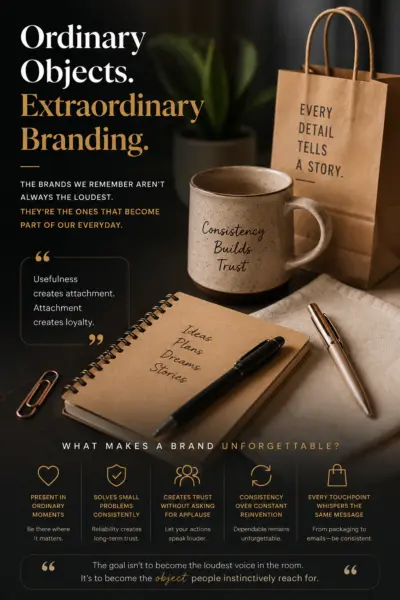
The Anatomy of Ordinary Things
What Everyday Objects Teach Us About Branding
There is something quietly remarkable about the objects we use every day.
A coffee mug. A notebook. A paperclip. A favourite pen that somehow writes better than the others. They rarely ask for our attention, yet we notice when they’re missing. They’ve become part of our routines, not because they shouted the loudest, but because they earned a place through consistency.
Brands aren’t very different.

Many businesses believe memorable branding begins with a striking logo, an expensive campaign, or a perfectly curated Instagram feed. While these elements matter, they are rarely the reason people stay. Just as we don’t keep reaching for the same mug because of its colour alone, people don’t return to a brand because of aesthetics alone.
They return because of familiarity.
Take a notebook, for instance. It begins as a blank collection of pages. Its value isn’t in the paper; it’s in what it quietly holds. Ideas. Lists. Sketches. Moments of uncertainty. Dreams written at midnight. Over time, it becomes personal, not because it demanded attention, but because it became part of someone’s story.
The strongest brands do the same.
They become present in ordinary moments. They solve small problems consistently. They create trust without asking for applause. Eventually, people stop thinking about choosing them. They simply do.
The anatomy of an ordinary object reveals something every marketer should remember: usefulness creates attachment, and attachment creates loyalty.
We often chase originality while overlooking reliability.
A spoon has barely changed in centuries because it already serves its purpose beautifully. It doesn’t reinvent itself every season. It simply works. In branding, consistency often carries more weight than constant reinvention. Audiences remember what feels dependable far longer than what merely feels different.
Even a paper bag tells a story.
When it’s thoughtfully designed, it transforms an ordinary purchase into an experience. The texture of the paper, the colour palette, the typography, the way it folds in your hand, these details communicate before a single word is spoken. Branding lives in these quiet moments, not only in advertisements.
That’s why the most memorable brands often feel effortless.
Their websites are easy to navigate. Their packaging feels intentional. Their emails sound human. Their colours become familiar. Every touchpoint whispers the same message instead of competing for attention.
Ordinary objects don’t try to become extraordinary.
They simply perform their purpose so well that life feels incomplete without them.
Perhaps that’s the lesson branding has been trying to teach us all along.
The goal isn’t to become the loudest voice in the room.
It’s to become the object people instinctively reach for.
Because in the end, people rarely remember the brand that interrupted them.
They remember the one that quietly became part of their everyday life.